
112 Columbus Avenue Feasibility Study

Before Demolition

After Demolition
Project Background
The 2.8 acre-site located at 112 Columbus Avenue sits within the adopted Downtown Rome Brownfield
Opportunity Area (BOA) and previously contained an abandoned former elementary school building. Following the closure of the school, the building was briefly used as a site for a Boys & Girls Club, and then as temporary headquarters for the Rome Police Department while the Justice Building on James Street was undergoing major repairs. The building was abandoned in 2005, condemned in 2022, and in spring of 2024 was demolished.
The Downtown Rome BOA highlights this redevelopment site as the largest contiguous developable parcel within the East Rome Residential Subarea and calls out potential compatible site uses including senior or transitional housing and market-rate housing such as townhomes and single-family residences. The site is proximate to East Dominick Street corridor, Pinti Field, the Mohawk River Trail, the Erie Canal Trail/ Empire State Trail, waterfront, downtown, and industrial areas.
Project Description

The City was successful in receiving funding from the New York State Department of State Brownfield Opportunity Area Program to progress the recommendation from the Downtown Rome Brownfield Opportunity Area (BOA) revitalization strategy to redevelop the former Columbus School site. The funding is being used to conduct a feasibility analysis to determine the most appropriate and feasible potential future use(s) of the site.
The Rome BOA 2.8-Acre Parcel Redevelopment Feasibility Analysis will include:
• An analysis of existing conditions on and around the site
• An analysis of redevelopment options for the site
• A financial feasibility analysis of proposed redevelopment options and the completion of redevelopment pro-formas
• A list of funding sources to address potential budgetary gaps associated with the redevelopment of the site based on the pro-formas
Feasibility Study Draft Components

A summary of existing conditions of the 112 Columbus site, including a review of zoning, environmental considerations, and infrastructure serving the site. The site is zoned for residential and limited commercial use and does not have any serious environmental concerns, although additional testing should be conducted in conjunction with any development to identify any possible coal ash from the former boiler at the school. However, water, sewer, electric, and gas facilities have all been disconnected and removed from the site. These utilities would need to be reestablished at the site as part of any development.
A data analysis assessing the need for and viability of housing and hotel developments in the City of Rome. The analysis then considers these findings in the context of the 112 Columbus site and provides recommendations regarding these uses at that site. In short, the site is well situated for residential development and offers a unique opportunity for creative design, but it is not an ideal location for visitor accommodations.

An overview of how comparable sites in similar communities have been redeveloped, including the new use of the site, project costs, community benefits, and funding partners. The case studies include a mixed-use apartment development in Binghamton, a brewery in Auburn, and a subdivision of cottage homes in Lockport, all in New York.
Proposed Concepts for Site Redevelopment
Below are various potential concepts for redevelopment of the site. Click on each image to see the whole plan.

Concept 1: Extend Existing Fabric
Concept 1 focuses on continuing the existing development patterns of the neighborhood, with a mix of single-family houses, duplexes, and small apartment buildings. This concept would align with the current zoning of the 112 Columbus site and would fit naturally within the surrounding neighborhood. As conceptualized, this concept would result in twelve single-family homes, four duplexes, and one apartment building with eight units, for a total of 28 new housing units on the site.

Concept 2: Tiny Houses
Concept 2 focuses on tiny and small home development with units under 1,000 square feet each. This concept features density and walkability as key characteristics. While the use would align with current zoning, lot sizes would be smaller than currently allowed by code. The single-unit tiny houses could be offered for sale or rent. Two designs are provided as shown in Concept 2 and Concept 3. This concept focuses on maximizing units and incorporates 38 single-unit tiny houses, two tiny duplexes, and two standard duplexes, for a total of 46 units.

Concept 3: Tiny Houses
Concept 3 is an alternative tiny home arrangement that provides more green space to facilitate community connectivity, and focuses less on density. This concept incorporates 28 single-family tiny houses and two standard duplexes, for a total of 32 units.

Concept 4: Town Houses
The fourth concept focuses on the development of town houses, which have a series of connected units. Town homes also provide a level of density that is attractive to developers in the current climate, but does not align as clearly with the current zoning of the site. The concept also includes a small commercial/retail building, perhaps for a community based-service like childcare or healthcare, or a personal care business like a salon. This commercial building could also incorporate apartments on a second story. The design below includes 30 town house units, two duplexes, and two apartments on the upper story of the commercial building, for a total of 36 units.
Concept 5: Community Green
Mixed Use
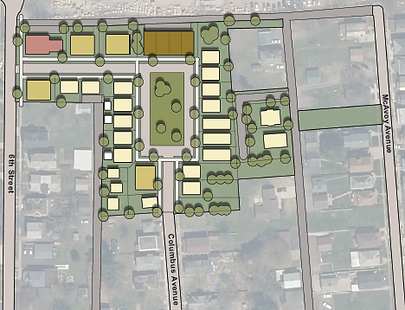
The final concept incorporates a mix of elements from each of the prior concepts, with each type of housing unit represented, a small commercial building, and community green space. While the uses proposed in this concept mostly align with the existing zoning and neighborhood character (with the exception of the town houses), some of the lots would still be smaller than currently allowed under code. That said, the concept provides a balance of density, walkability, and open space. The concept design includes four tiny houses, 18 single-family homes, six duplexes, and four town houses, for a total of 38 units. Apartment units could also be added on the second floor of the commercial building, assuming adequate parking was available for tenants.